Menus that work on mobile
Readable dishes and dietary notes, using your approved menu content.
Newzchain Studio / US businesses
Readable menus and useful event enquiries, built around your catering service and the way your team prepares a quote.
Built around your business
Readable dishes and dietary notes, using your approved menu content.
Date, guests, location and service style collected for staff review.
Help visitors understand weddings, corporate events and private catering.
Some catering sites offer one general contact box for every event. The resulting message may omit the date, guest count, venue or service style. A short structured enquiry can ask for those details and leave room for questions. It should distinguish a preferred date from a confirmed booking and tell the visitor what happens after submission.
Other sites list weddings, private parties and corporate catering without showing how those services differ. A person arranging an office reception may need delivery and staffing details; a wedding planner may need tasting, setup and venue coordination information. Separate sections can explain these differences within an agreed page scope.
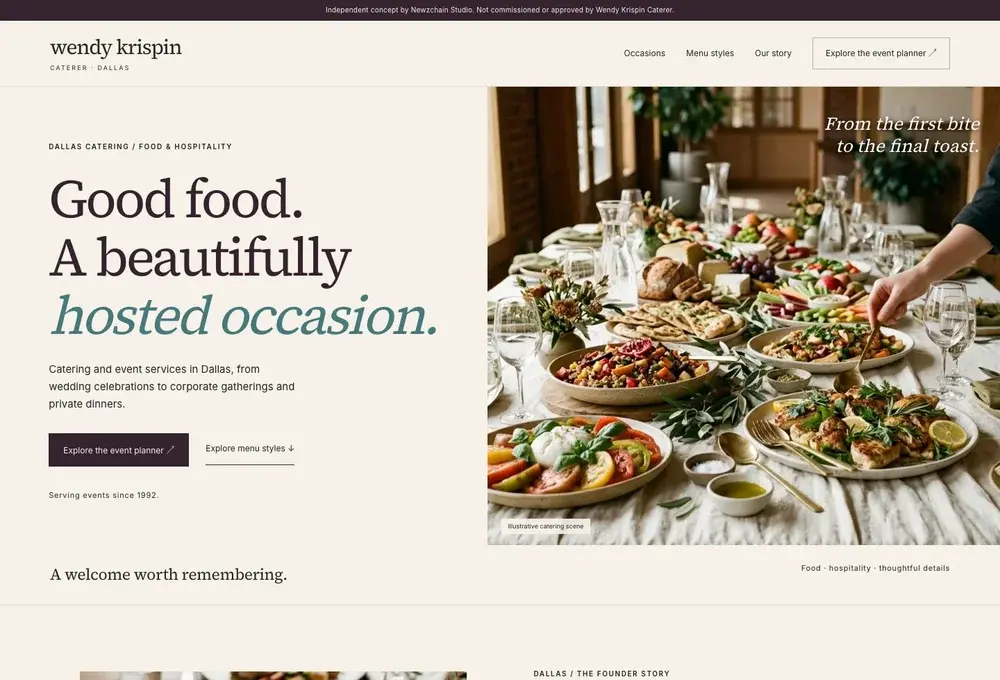
Repeated photographs can make a gallery hard to interpret. A plated dish, a staffed buffet and a room setup answer different questions. Use approved images with descriptive captions, consistent crops and accurate credits. Avoid presenting stock photographs as evidence of an event your business catered.
Service areas and practical limits also deserve a clear place. Visitors need to know whether you travel to their venue, whether travel is quoted separately and who supplies equipment. These are business decisions supplied by you, not assumptions we make from a map.
The agreed informational website can include mobile menus, occasion sections, a service-area explanation, a curated gallery and real authorised review highlights. The enquiry form can collect event date, approximate guest count, venue location, service style and dietary notes. We keep required questions focused so someone who is still planning can explain what they know.
For example, a private dinner enquiry might offer a guest-count range and a field for the address or area. A corporate enquiry might ask whether the event needs delivery only or staff on site. You approve the wording and the recipient before launch. Collecting a request does not confirm availability, a menu price or a booking.
If weddings, corporate events and private events need full separate pages, we agree how they fit within the three-page Launch scope or quote extra pages. Menus and galleries should support the visitor’s decision rather than become an unbounded content project. You provide current offerings, licensed photographs and approved business facts.
An enquiry should arrive in an account your business controls. The confirmation tells the visitor the request was received and explains the next step your team has agreed. It should not promise a response time that nobody can maintain. We test missing fields, malformed email addresses and delivery failure with synthetic details before launch.
Existing event-management software can remain the place where staff build proposals and confirm work. A website link, embedded supported form or separately scoped integration can connect the journey. We inspect the software’s available options before promising that every enquiry will appear in a dashboard. Provider subscriptions and integration maintenance are separate costs.
We start with a draft concept so you can review the proposed structure and visual direction. You approve the design, pay the first 50% of Launch, and we finish the agreed website using your approved content. The final 50% is due before production launch. A free concept request is reviewed for fit; it is not a promise of a complete free website or a confirmed project.
The three-business-day first-draft target begins after the required brief, content and access are available. A launch-ready website in as little as five business days depends on agreed informational scope and timely consolidated feedback. Complex menu systems, cinematic assets and operational integrations have separate schedules. Website Plan uses its own setup and monthly payment schedule, not Launch’s two project payments.
An atmospheric hero or scroll film can show a food and event setting when asset rights, production brief and mobile performance are agreed. It starts from $499 and is separately scoped; the detailed concept film is not automatically included at that starting price.
A bounded enquiry workflow or staff dashboard starts from $1,200. It can help a team review defined event fields and track a limited process, but is not a full CRM. An AI missed-call receptionist can collect enquiry details when your team cannot answer, subject to forwarding, consent and an agreed minutes allowance. Review request automation can follow completed jobs without filtering unhappy customers.
Launch: $899 one-time, 50% after design approval and 50% before launch. Three months of Website Care from production launch, then $69/month with recorded agreement or $690/year only with express annual selection. Opt out at kickoff. Website Plan: $299 setup plus $149/month, 12 paid monthly instalments, $2,087 minimum before applicable taxes and approved extras. Care is included.
We can agree a supported editing route or use included minor-edit time for supplied changes. A full menu-management application is separate scope.
Show approved starting prices, ranges or minimum orders when they help customers understand fit. Explain what changes the quote; never present a guide price as a binding event quote.
We inspect supported links, forms and APIs first. Keep your current software for proposals and confirmed bookings; custom integration is separately quoted.
Current menus, event types, service areas, approved photographs, real review permissions, contact details and access to the accounts needed for launch.
A first draft can be ready in three business days after prerequisites. Final launch depends on scope and timely feedback; integrations and asset production have separate timelines.
You own your domain and supplied content. Launch code transfers after full payment; Website Plan after 12 paid months or an agreed remaining-balance buyout. Third-party licences apply.
No. It collects an enquiry for your team to review. Availability, proposals, deposits and confirmed bookings need your existing process or separately scoped software.