Show each space clearly
Approved capacity details, representative images and practical information.
Newzchain Studio / US businesses
Show the spaces, explain practical details and make a tour request easy without promising availability before your team checks it.
Built around your business
Approved capacity details, representative images and practical information.
A clear request route with your team confirming the visit.
Approved pricing guidance, suppliers and important planning conditions.
A venue gallery can be beautiful while leaving basic planning questions unanswered. Couples may want to know where a ceremony happens, how a reception is arranged and what changes when the weather does. A named space section lets a photograph sit beside useful details instead of asking the visitor to infer everything from a slideshow.
We use capacity figures and layouts you approve. Seated dining capacity, standing reception capacity and ceremony capacity may differ. Each number needs its context. A garden, chapel and reception room should not inherit the same capacity claim simply because they belong to one venue. Accessibility, toilets and parking details also need current venue confirmation.
One common pattern is a gallery that mixes ceremony spaces, receptions and styled shoots without labels. A visitor cannot tell which room is pictured or whether the arrangement is available for their event. Captions and space names make those photographs useful. Real event images need appropriate permissions, and styled scenes should be identified honestly.
Another pattern is pricing information hidden behind a general enquiry. A venue may prefer a quote rather than a fixed package, but can still explain what determines it. Season, guest count, hire duration and included services are useful factors when they reflect the actual offer. Publish only ranges or examples your team is willing to stand behind.
Tour requests can also be buried beneath repeated contact links. A clear request action lets visitors give a preferred day and their planning stage. The confirmation must say this is a request, not a booked tour. Staff still check the calendar and reply with a confirmed arrangement.
Policies sometimes sit in a downloadable file with no nearby explanation. Couples need to find guidance on outside suppliers, catering, noise, access and weather arrangements. A concise policy FAQ can link to your current contract rather than paraphrase important conditions inconsistently.
An agreed venue website can combine a space overview, package or price-range guidance and a contact/tour page. The final three-page structure follows your priorities. Full individual space pages can be quoted separately when the venue needs more depth. We plan navigation so people can move between capacity, images and the next action without losing context.
A gallery should show representative spaces and arrangements with approved descriptions. A preferred-vendor section can explain whether suppliers are suggestions, requirements or paid partners. It must not imply an endorsement or commercial relationship you have not authorised. Review highlights use genuine reviews with permission and accurate attribution.
The tour form can collect preferred visit timing, anticipated event date, approximate guest count and a question. Optional fields help visitors who have not chosen a date. Avoid asking for sensitive guest information at this stage. Your staff receives the request and follows the response process agreed before launch.
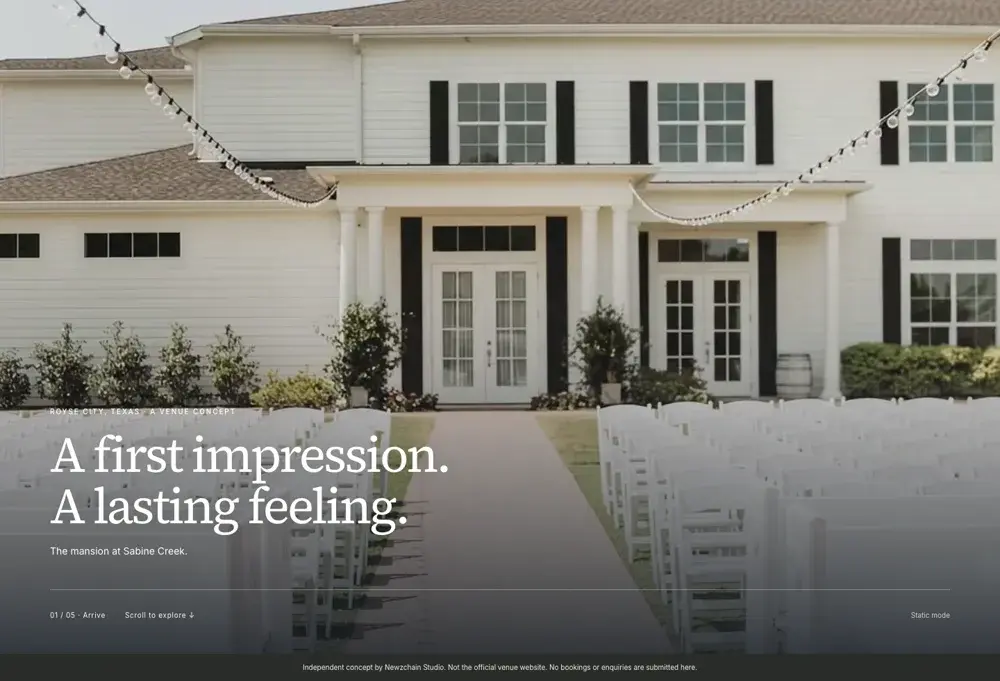
A cinematic hero or scroll film can convey the feel of a venue. It is an atmospheric film, not a measured 3D tour, floor plan or proof of dimensions. Camera movement and generated scenes should not be used to establish room capacity or accessibility. Real planning facts belong in text and approved diagrams.
Cinematic media starts from $499 for separately agreed production, licensing and performance scope. A complex concept sequence may require a larger budget. Static posters and reduced-motion fallbacks protect the information journey. Visitors can understand the venue and request a tour without watching a film.
The public website should connect to the venue’s current calendar or sales software through a supported link or separately scoped integration. An informational form does not reserve a date, issue a contract or take a deposit. Those operations need permissions, reliable data and failure handling that we agree separately.
A bounded staff dashboard starts from $1,200 and can cover a defined request-review workflow. An AI missed-call receptionist can collect details and send a summary, but does not make binding quotes or confirm dates without an approved calendar connection. Keep a human responsible for contractual commitments and changes to venue availability.
We build a first draft concept for a fit review. Once you approve the Launch design, the first 50% project payment is due and we complete the agreed site with your content. The remaining 50% is due before launch. You keep your domain and supplied material; custom code transfers after full payment, subject to third-party licences.
The first-draft target is three business days after the required brief, content and access are supplied. Launch-ready in as little as five business days depends on scope and prompt consolidated feedback. Seasonal rates, supplier rules and capacity facts need a named reviewer. Website Plan instead uses setup at kickoff and monthly billing from launch with its stated minimum term.
Launch: $899 one-time, 50% after design approval and 50% before launch. Three months of Website Care from production launch, then $69/month with recorded agreement or $690/year only with express annual selection. Opt out at kickoff. Website Plan: $299 setup plus $149/month, 12 paid monthly instalments, $2,087 minimum before applicable taxes and approved extras. Care is included.
Approved package prices, ranges or the factors affecting a quote can help visitors assess fit. Explain dates and inclusions; do not turn illustrative guidance into a promised quote.
Yes. Provide approved seated, standing and ceremony figures for each space, with the relevant layout and limitations.
No. It is atmospheric media. Measured layouts, dimensions and accessibility information must come from approved venue facts.
The included form requests a tour. Confirmed scheduling requires a supported calendar or separately scoped booking integration.
Licensed images of each space and representative arrangements, with accurate captions and permission for identifiable people where needed.
Yes, where supported. We review available links/forms/APIs and scope custom integration separately.
Domain and supplied content remain yours. Launch code transfers after full payment; Website Plan after 12 paid months or an agreed earlier buyout. Third-party licences apply.